Leadership

Deputy Head · since 2022
Melbourne Health Economics
- Research staff53
- PhD students16
- Units4
- Honorary & affiliated9
Melbourne Health Economics is the health economics program of the Centre for Health Policy at the University of Melbourne. Ilias has been its Deputy Head since 2022.
MHE brings together 53 research staff, 16 PhD students and 9 honorary and affiliated members across four units. It is one of the larger concentrations of health economics capability in Australia, and it works across the full span of the discipline rather than a single disease area or method.
The Deputy Head role is an operational one: strategic leadership, line management, mentoring, and a seat on the Senior Leadership Group. In 2023 Ilias established a health economics internship programme within the Master of Genomics and Health, placing students inside MHE and the Economics of Genomics and Precision Medicine Unit.
Inaugural Head · founded 2023
Economics of Genomics and Precision Medicine Unit
- Researchers14
- Research officer1
- Honorary staff3
- Founded2023
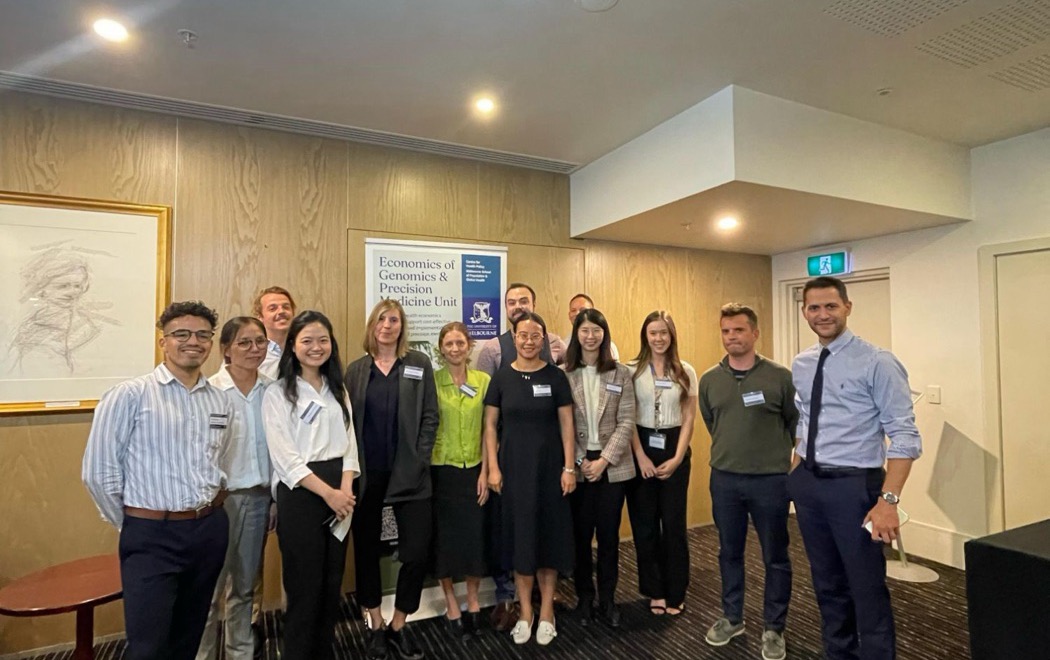
Ilias founded the Economics of Genomics and Precision Medicine Unit in 2023 and is its inaugural Head. It is the largest capacity-building effort in this field in Australia, and internationally.
The unit currently brings together fourteen researchers, a research officer and three honorary staff members. Its work is the applied core of the four questions the research is organised around: what genomic technologies actually cost, what people value about them, how that evidence reaches a funding decision, and what can and cannot be automated in producing it.
Building it meant building a field. When the unit started there was no standing group anywhere doing this work at scale, which is why the capacity, the methods and the people are as much the output as the papers are.
Economics Lead · 2018 to 2025
Australian Genomics
- Partner organisations100+
- Participants evaluated5,200+
- Flagship studies19
Australian Genomics was a national collaborative partnership of more than 100 organisations, piloting a whole-of-system approach to integrating genomics into healthcare. Ilias led its health economics programme from 2018 until the work concluded into Genomics Australia in 2025.
Across its first five years the programme evaluated the outcomes of genomic testing in more than 5,200 people, across 19 rare disease and cancer flagship studies. The economics work built the methods to measure what all of that was worth, not only whether it was cheaper: quality of life data from parents and children that established significant health spillover onto families, and preference elicitation with 3,255 members of the Australian public and study participants.
That evidence went where it counts. Genomic testing for syndromic and non-syndromic intellectual disability, genetic cardiac disorders, genetic kidney disease and a range of cancers passed health technology assessment at the Medical Services Advisory Committee and is now publicly funded.
Read the five-year outcomes paper in the American Journal of Human Genetics ↗
Founding and Lead Convener · established 2021
Econ-Omics: the iHEA Special Interest Group
- Members130
- Leadership group12
- Established2021
The Economics of Genomics & Precision Medicine Special Interest Group of the International Health Economics Association. Ilias established it in 2021 and convenes it.
Governments are investing in genomics faster than the evidence base for valuing it has developed. Econ-Omics exists so that there is a health economics voice in that gap: a standing global network building the capacity, methods and evidence that resource allocation decisions in genomic medicine require.
- Connect researchers working on health economics in genomics across countries, and link them to people outside the group who can move the methods forward.
- Generate ideas through dialogue on how resources should be allocated in genomics, and on the value judgements buried in the methods.
- Enable collaboration and dissemination, identifying gaps between countries, and turning them into publications and grant applications.
- Support low- and middle-income countries and early-career researchers, including recruiting them into convener roles rather than only into audiences.
In practice that means an annual symposium, a webinar series, a blog and newsletter, coordinated conference sessions, cross-regional mentoring and shared teaching materials.
Next
Capacity is the output that outlasts the papers.
Four bodies, built to outlast any single project: the methods, the evidence, and the people now doing the work.